Monday, June 7, 2010

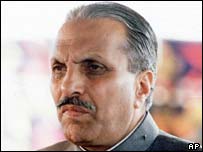
Ghulam Ishaq Khan (1915-2006)


Ghulam Ishaq Khan (20 Jan, 1915- 27 Oct, 2006) also known as Mr. Nuke or "Baba Atom Bomb", was the seventh President of Pakistan from 17 Aug, 1988 -18 July, 1993.He was a powerful player in the political equation of Pakistan.Under the constitution, the President of Pakistan is elected by a majority of the members of the National and Provincial Assemblies. Ishaq Khan was a seasoned senior bureaucrat-turned politician who had been a key figure in Pakistan for more than three decades. He was born in 1915 in the NWFP and completed his education in BS and MS from Peshawar University.  He was appointed to the prestiguous Civil Service of Pakistan after Independence in 1947. After holding various regional posts, including chairman of the West Pakistan Water anf Power Development Authority (1961-66), he was appointed to several positions in the central Govt -as secretary , Ministry of Finance (1966-70), and later as Governor of State Bank of Pakistan (1971-75). He was subsequently moved from the Bank and made Secretary General at  the Ministry of Defence. Although an unusal post for senior economics expert, it proved to be fortuitous in that it brought him close contact with senior officers of the aarmed forces.Among them was General Zia, who later ousted Bhutto and turned the management of the economy over to Ishaq Khan. During the martial law period (1977-85), Ishaq khan's titles changed, but he was responsible for all important economic decisions.Among other things he supported the Zia Government's efforts to Islamize the economy by changes in the fiscal and banking system.
        
In 1985, Ishaq Khan was elected to the Senate and later became chairman of the Senate.The death of Zia in 1988, thrust Ishaq Khanto the center of the political stage.When the military decided to use the constitution to handle the issue of  succession , Ishaq Khan, as Chairman of the Senate and therefore next in the line of succession , became acting President.. He and the emergency council he instituted decided to  hold general elections and to allow political parties to participate. Thus he country was guided back to democracy, Benaziir became Prime Minister, and Ishaq Khan was  subsequently elected preident by the National and Provincial Assemblies.
Ishaq Khan's position was considerably strengthened by the eighth amendment of the constitution done by Zia, in 1988.But in late 1992 and early 1993, the political tension he was eventually ndropped as a candidate infavour of Farooq Ahmaed Khan Legari. Ishaq died on Oct 2006.
He was one of the Key person of Pakistan's nuclear programme.  


Sunday, June 6, 2010

Zia-ul-Haq (contd-1)

Zia was born in Jalandhar, British India, in 1924 of Muhammad Akbar, who worked as a senior clerk in the army GHQ in Delhi and Simla pre-partition.
After Graduation from St.Stephen's College in Delhi, Zia joined the British Indian Army in 1943. He married Shafiq Jahan in 1951.One of his sons went into politics  (Muhammad Ijaz-ul-Haq)becoming a cabinet minister in the Govt of Nawaz Shariff.
He was commissioned in the British Indian Army in a cavalry regiment on      12 May 1943 and served against Nazi Germany and its Allies in WW II. After Pakistan gained its Independence, Zia joined the newly formed Pakistan Army as a major.He was trained in the United States in 1962-1964 at the US Army Command and General Staff College Fort Leavenworth, Kansas. After returning,  he took over charge as Directing Staff (DS) at Command and Staff College, Quetta. During Indo-Pakistan War Zia was a tank commander.
Zia was stationed in Jordan from 1967 to 1970 as a Brigadier, helping in the training of Jordanian soldiers, as well as leading the training mission into battle during the Black September Operation  as a commander of Jordanian 2nd Division, a strategy that proved crucial to King Hussein's remaining in Power. By 1973, then Maj. Gen. Zia was commanding the first Armoured Division at Multan.
He was then promoted to Lt. Gen and was appointed commander of the II Strike Corps at Multan in 1975.
On March 1, 1976, Prime Minister Zulfikar Ali Bhutto approved Zia-ul-Haq as Chief of Army Staff.
But Prime Minister Bhutto began facing cosiderable criticism and increasing unpopulaity as his term progressed.
On 8 jan 1977, a large number of opposition political parties grouped to form the Pakistan National Alliance (PNA). Bhutto called fresh elections. On 5 July, 1977, Bhutto and members of his cabinet were arrested by the troops under the order of general Zia.
After assuming Power as Chief Martial law Administrator , Gen Zia promised to hold national and provincial election within 90 days.

Nusrat Bhutto, wife of Bhutto, filed a suit against Zia but supreme court justified Zia's action.
Gen Zia instead of holding election took a referendum on 1 Dec 1984, which showed 95 % in favour of Zia.
Zia participated in Soviet-Afghan war against USSR.
Zia slowly reversed the nationalisation policy and experienced an annual growth of 6.8 % in the GNP.
Gen Zia enforced Sharia law and implemented Islamisation in Pakistan.
Zia introduced Hudood ordince ; By nwhich he enforced the amputation of right hand from its wrist and left leg from its ankle as a punishment for doing some illegal activities.
He died in a plane crash while coming from US.    

Saturday, June 5, 2010

Muhammad Zia-ul-Haq (1924-1988)

Muhammad-Zia-ul-Haq
In Office
16Sep 1978-17 Aug 1988
Prime Minister : Muhammad Khan Junejo
Preceded by ; Fazal Ilahi Choudhury
Succeeded by ; Ghulam Ishaq Khan
____________________________________
Prime Minister of Pakistan
In Office
9June 1988-17 Aug 1988
Prcceded by   Muhammad Khan Junejo
Succeeded by    Benazir Bhutto
In Office
5 July 1977-24March 1985
President   Fazal Ilahi Choudhury
Preceded by   Zulfikar Ali Bhutto
Succeeded by  Muhammad Khan Junejo
_______________________________________
Chief of Army Staff
In Office
11 Oct 1976- 17Aug 1988
Preceded by   Tikka Khan
Succeeded by   Mirza Aslam beg
_____________________________________
Born        12 Aug 1924
Jalandhar, British Raj (now India)
Died   !7 Aug 1988
Bahawalpur, Pakistan
Alma Mater   United States Army Command and
general Staff college
Religion   Sunni Islam
Military service
Allegiance    Pakistan
Service branch   Pakistan Army (PA-1810)
Years of Sevice   1943-1988
Rank    General
Unit   Armoured Coros (Guides cavalry FF)
Commands  2nd Independent Armoured Brigade, Jordan
1st Armoured division, Multan
II Corps, Multan
Chief of Army Staff
Battles/wars      WW  II
Indo-Pakistan war of 1965
Black Sep in Jordan
Soviet war In Afghanistan.    

Friday, June 4, 2010

Zulfikar Ali Bhutto (1928-1979) (contd-1)

In 1962, he was appointed Pakistan's Foreign Minister. His swift rise to power also brought him national prominence and popularity. As foreign Minister, Bhutto siginicantly transformed Pakistan's hitherto pro-Western foreign policy . While mentioning a prominent role for Pakistan within the South East Asia Treaty Organistation and the Central Treaty Organisation.Bhutto worked to establish strong relationship with People's Republic of China. Bhutto visited Beijing and helped Ayub  negotiate trade and Military agreeements with the Chinese regime.on March 1963 that transferred  Bhutto also signed Sino-Pakistan boundary agreement on March 1963that transformed 750 sq. kilometres of territory from Pakistan Administered Kashmir  to Chinese Control. Bhutto asserted his belief in non-alisnment, making Pakistan an influential member in non-aligned organisations. Believing in pan-Islamic unity , Bhutto developed closer relations with nations such as Indonesia, Saodi Arab and other Arab States.
Bhutto advocated hardline and confrontational policies against India over the Kashmir conflict. A 17-day war, known as the Indo-Pakistani War of 1965 was settled in Tashkent with the Indian Prime Minister Lal Bahadur Shastri where Bhutto joined Ayub.
This agreement was deeply unpopular in Pakistan, causing major political unrest against Ayub's regime . Bhutto began travelling across the country and impressed the supporters of PPP that "Islam is our faith, democracy is our policy, socialism is our economy, All power to the people."
Following Ayub's resignation, the new president Gen Yahya Khan promised to hold parliamentary elections on Dec 1970, Bhutto's Party won a large number of seats from constituencies in West Pakistan. But Sheikh Mujibur's Awami League won an outright majority from the constituencies located in East Pakistan. Bhutto refused to accept an Awami League Govt. and famously promised to "break the legs" of any elected PPP member who dared to attend the National Assembly and thus the Bangladesh was created.
Bhutto visited India to meet Prime Minister Indira Gandhi and negotiated a formal peace agrement and the release of 93,000 Pakistani Prisoners of War and agreed to a new yet temporarily ceasefire line in Kashmir 
President of Pakistan    
A Pakistan International Airlines plane was sent to fetch Bhutto from New york, where he was representing Pakistan's case in United Nations Security Council on the East Pakistan crises  on Dec 1971. On Dec 20 he was taken to the President House in Rawalpindi where he took over two positions from Yahya Khan, 1. President,2. Chief martial Law Administrator.
He took steps to ameliorate poverty and to revitalise the economy, industry and agrculture.In early 1972, Bhutto nationalised ten categories of major industries and withdrew Pakistan from the Common Wealth of Nations and SEATO. On March he introduced extensive land reforms. On July 2, 1972, he signed the Simla Agreement with India for exchange of the occupied territories and release of Prisoners of War. After the 1973 constitution was promulgated, Bhutto was elected by the house to be the prime Minister, and he was sworn in on 14 th Aug 1973.
Father of the Nuclear programme
Zulfikar Ali Bhutto was the founder of Pakistan's nuclear programme . After India's Nuclear test on May 1974, Prime Miniater Bhutto determined to be equipped with the nuclear weapon.In a conference convened for the purpose he reiterated that he wanted Nuclear power within three years and gave the charg to Dr. S.A.Butt
He was replaced by Zia-ul-Haq by a coup in 1977 and Bhutto had to face a trial on charges of conspiracy of trial.Bhutto was hanged on Mar, 1979 at central Jail.

Thursday, June 3, 2010

Zulfikar Ali Bhutto (1928-1979)

Early Life:
Zulfikar Ali Bhutto was born of Khursheed Begum nee Lakshmi Bai and Sir Shah Nawaz Bhutto., 0n 5th Jan 1928. He was born in a prominent Sindhi Si'a Muslim Arain family. His father was a wealthy land lord, a zamindar, and a prominent politician in Sindhi. Zulfikar Ali Bhutto completed his early education from Bombay's Cathedral High School. In 1947, he joined the University of Southern California  and later the University of California at Berkeleyin June 1949.After completing its degree in honors degree in Political Science at Berkeley  Here he would become interested in the theories of socialism, delivering a series of lectures on the feasibility of socialism in Islamic countries.  In June 1950, he was admitted to Oxford. He married Nusrat Ishphahani on Sep. 1951..He was called to Bar at Linconn's Inn in 1953, and the same yearhis first child Benazir was born. On his return to Pakistan, Bhutto accepted the post of lecturer at the Sindh Muslim College, from where he was also awarded a law degree by then College President Mr. Hassanally A. Rahman before establishing himself  in a legal practice in Karachi. He also took over the management of his family's estate and business interests after his father's death.  
Political career :  Sheikh Abdullah with Ayub and Bhutto, 1964.
In 1957, Bhutto became the youngest member of Pakistan's delegation to the United Nations. He would address the United Nations Sixth Conference on Aggreeion on Oct 1957 and lead Pakistan's deputation to the United Nations Conference of the law of the seas in 1958. In the same year , Bhutto became the youngest   Pakistani Cabinet Minister when he was given the charge of the Energy Ministry by President Muhammad Ayub Khan , who had seized power and declared martial law. He was subsequently promoted to head the ministries  of commerce, information and industries. Bhutto became a closed and trusted advisor to Ayub, rising in influence and power despite his youth and relative inexperience in politics. Bhutto aided Ayub in negotiating the Indus Water Treaty with India in 1960. In 1961, Bhutto negotiated an oil exploration agreement with Soviet Union, which also nagreed to provide economic and technical aid to Pakistan.      

Tuesday, June 1, 2010

Yahya Khan (1917-1980)

General Agha Muhammad Yahya Khan was born at Chakwal in Feb. 1917.His father Saadak Ali Khan, was actually from Peshawar. After finishing his studies at the Punjab University, Yahya Khan joined the Indian Military Academy at Dehra Dun. He was commissioned  in the Indian Army in 1918.His early postings were in he NWFP. During WWII, he performed his duties in North Africa, Iraq, and Italy.  After Independence, Yahya Khan played a major role in setting up Pakistan Staff college at Quetta. During the war of 1965, he commanded an infantry division. He was appointed Commander-in-Chief of Pakistan Army in 1966 with the rank of General.
An infantry officer Yahya saw action during WW II in North Africa where he was captured by the Axis power in June 1942 and interned in a prisoner of war camp in Italy from where he escaped in the third attempt.
In 1947,he was instrumental in not letting the Indian officers shifting the books from the famous library of the British Indian Staff College at Quetta, where Yahya was posted at the only Muslim instructor at the time of Partition of India. He was deployed in Kashmir in 1951-52. Later he was selected as deputy Chief of General Staff from 1958 to 1962 from where he went on to command an infantry division from 1962-1965.
After being Commander-in-Chief he reorganised  the Pakistan Army in 1965. Soon after the war, between India and Pakistan, had started, US had imposed an embargo on military aid on both India and Pakistan.
At the end of 1960s Ayub Khan relinquished his charges to Yahya Khan due to mass scale resentment against Ayub.
Yahya Khan dissolved both the assemblies of State and Center and Promised to hand over charges to elected persons.
Yahya announced in his broadcast  to the nation on 28 July 1969, his firm intention to redress Bengali grievances, the first major step in this direction being, the doubling of Bengali quota in the defence services.
Within a year he had set up a framework for elections that were held in Dec. 1970.
In East Pakistan, the Awami League (led by Mujibur Rahman ) held almost all of the seats, but none in West Pakistan. In West Pakistan , the Pakistan People's Party (led by Zulfikar Ali Bhtto) won the lion's share of the seats, but none in East Pakistan. Although AL had 162 seats in the National Assembly against 88 of PPP, this led to a situation where Bhutto would have to give up powerand allow Mujib to become th Prime Minister of Pakistan. Yahya could not reach a compromise , and a massive campaign of genocide, named "Operation Searchlight" took place.This resulted a total of 3 million people in east pakistan were wiped out and another 400,000 women were brutally raped. On the genocide Yahya quoted " Kill 3 million of them (Bangladeshi), and the rest will eat out of our hands."
But ultimately a war netween East and West Pakistan took place. Withn the help of India Bangladesh won freedom.
Yahya had to surrendor to Zulfikar Ali Bhutto.
Yahya died in Aug 1980.