Monday, May 23, 2011

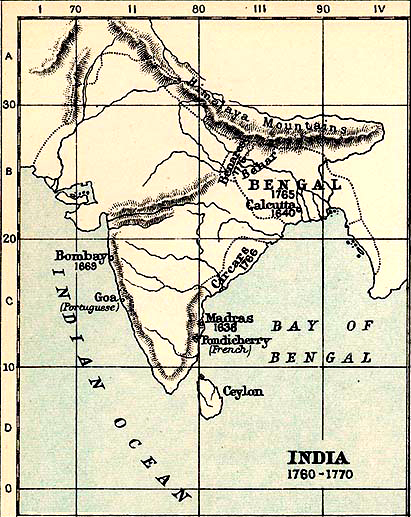
Wars fought during Clive to Wellesly

That both had consciously formed the design of acquiring a great empire in India to compensate for the loss of the American colonies is not proved; but the rivalry with France, which in Europe placed Britain at the head of coalition after coalition against the French republic and empire, made Mornington's rule in India an epoch of enormous and rapid extension of British power. Robert Clive won, laid down the foundation stone of British Empire in India and Warren Hastings consolidated the British ascendancy in India, but Mornington extended it into an Empire. On the voyage outwards, he formed the design of annihilating French influence in the Deccan.
These three persons 1. Robert Clive, 2. Warren Hastings, and 3. Lord Wellesly completed the process of putting India into the centre of the colonial country of British Empire.
1757, 23rd June Battle of Plassey : The whole Mughal army was defeated. Mir jaffar betrayed and joined with Clive. Clive got 8 lakh pound from Mir Jaffar and offered him the Masnad. The eldest son of Shah Alam, Sahajada, was also defeated by Clive and got a land from Mir Jaffar with a revenue potentioal of 30,000 pound.
1761, 6 Jan Sadashib Rao and Ahmed Khan Abdali was defeated at Battle of Panipath.
1760, Vancitart was appointed as Governor of Bengal. He replaced Mir Jaffar by Mir Kashim who paid regularly 2 lakhs pound and he gifted one-third of his kingdom i.e., Mednipore, Burdwan and Chattagram to East India Company.
Clive was again appointed as Governor with the power of Chairmanship of a four member Council consisting of General Karnak, Mr. Verelest, Mr. Samnar, and Mr. Saicks. Clive made  Nawab Nazimuddin Daulah of Bengal, Bihar and Orissa to resign against Rs. 53 lakhs annually. He paid 26 lakhs to Mughal-e- Ajam who handed over all power to Clive.     

Wednesday, May 18, 2011

Richard Wellesly, 1st Marquess Wellesly

  
Wellesley was born in 1760 in Ireland, where his family were part of the aristocracy. He was educated at Harrow School and Eton College, where he distinguished himself as a classical scholar, and at Christ Church, Oxford.

In 1780, he entered the Irish House of Commons for Trim until the following year, when by his father's death he became 2nd Earl of Mornington, taking his seat in the Irish House of Lords. He was elected Grandmaster of the Grand Lodge of Ireland in 1782, a post he held for the following year.
In 1784 he joined also the British House of Commons as member for Bere Alston. Soon afterwards he was appointed a Lord of the Treasury by William Pitt the Younger.
In 1793 he became a member of the Board of Control over Indian affairs; and, although he was best known for his speeches in defence of Pitt's foreign policy, he was gaining the acquaintance with Oriental affairs which made his rule over India so effective from the moment when, in 1797, he accepted the office of Governor-General of India.
 Work in India
 Wellesley in his red-coated officer's uniform.
Mornington seems to have caught Pitt's large political spirit in the period 1793 to 1797. That both had consciously formed the design of acquiring a great empire in
India to compensate for the loss of the American colonies is not proved; but the rivalry with France, which in Europe placed Britain at the head of coalition after coalition against the French republic and empire, made Mornington's rule in India an epoch of enormous and rapid extension of British power. Robert Clive won and Warren Hastings consolidated the British ascendancy in India, but Mornington extended it into an empire. On the voyage outwards, he formed the design of annihilating French influence in the Deccan.
Soon after his landing, in April 1798, he learned that an alliance was being negotiated between Tippoo Sultan and the French republic. Mornington resolved to anticipate the action of the enemy, and ordered preparations for war. The first step was to effect the disbandment of the French troops entertained by the Nizam of Hyderabad.
The invasion of
Mysore followed in February 1799, and the campaign was brought to a swift conclusion by the capture of Seringapatam on 4 May 1799 and the killing of Tippoo Sultan. In 1803, the restoration of the Peshwa proved the prelude to the Mahratta war against Sindh and the raja of Berar, in which brother Arthur took a leading rĂ´le. The result of these wars and of the treaties which followed them was that French influence in India was extinguished, that forty million people and ten millions of revenue were added to the British dominions, and that the powers of the Maratha and all other princes were so reduced that Britain became the true dominant authority over all India. He found the East India Company a trading body, but left it an imperial power.
He was an excellent administrator, and picked two of his talented brothers for his staff: Arthur was his military adviser, and Henry was his personal secretary. He founded Fort William College, a training centre intended for those who would be involved in governing India. In connection with this college, he established the governor-general's office, to which civilians who had shown talent at the college were transferred, in order that they might learn something of the highest statesmanship in the immediate service of their chief. A free-trader like Pitt, he endeavoured to remove some of the restrictions on the trade between Britain and India.
Both the commercial policy of Wellesley and his educational projects brought him into hostility with the court of directors, and he more than once tendered his resignation, which, however, public necessities led him to postpone till the autumn of 1805. He reached England just in time to see Pitt before his death. He had been created a Peer of Great Britain in 1797, and in 1799 became Marquess Wellesley in the Peerage of Ireland.
He formed an enormous collection of over 2,500 painted miniatures in the Company style of Indian natural history

Wednesday, May 11, 2011

Kingdom of Mysore, Hyder Ali & Tipu Sultan

Founded by the Wodeyar dynasty, the Kingdom of Mysore in the Southern part of India has a rich and glorious history. The Kingdom of Mysore was however ruled by different dynasties from time to time beginning with the Wodeyar dynasty, followed by Hyder Ali and Tipu Sultan. The Kingdom was plundered by many foreign powers from time to time but still succeeded in maintaining its glamour and heritage.
The Kingdom of Mysore was established by the Wodeyar brothers, Vijaya Wodeyar and Krishna Wodeyar in the year 1400. It remained a feudatory of the Kingdom of Vijaynagar until the latter declined in the second half of the 16th Century. The Kingdom of Mysore grew and flourished in the able hands of Chikka Devaraja Wodeyar. As the Kingdom of Mysore became independent it expanded and gradually engulfed most of the parts of Southern India.
A favorite of the Maharaja Krishnaraja Wodeyar two, Hyder Ali was just a soldier in the Mysore army. He went on to become a de facto ruler during the reign of the minor Raja Nanjaraja Wodeyar. After the death of Hyder Ali his son Tipu Sultan became the de facto ruler of the kingdom. He has fought the British bravely and even defeated them in the second Mysore war. Tipu was defeated and killed in the fourth Mysore war in the year 1799.
After the Britishers captured Mysore, they placed Krishnaraja Wodeyar three, a minor, on the throne of the Kingdom of Mysore. The Kingdom of Mysore thus became a princely state of British India.

Monday, May 9, 2011

Economic condition of Bengal after British victory (contd-2)

After suppression of revolt of the farmers of Banaras in 1781, the farmers of Ayodhya flared up with their demands.The East India Company was forcing the land lords of Ayodhya to compensate the growing expenses of the British soldiers and forced them to lent more lands. For want of support from other sections of the society the revolt of the farmers were defeated by the powerful soldiers of the feudalists. The heavy presure of taxation of the British brought  famine in Ayodhya, even then Hastings did not reduce the tax. Hence forth the Nawab of Ayodhya was rescued by the soldiers of British from the hands of the famine-distressed farmers.
Moreover, to maitain the balance of fund of the treasury, some feudals had to loose their property in the hands of the East india Company. This was another reason of displeasure among the feudalsts of Ayodhya. Under the leadership of the adopted and exiled son of the ex-Nawab, Oazed Ali, the feudals ( both Hindu and Muslim) became united.All the traders of Bengal along with the Armenians of Calcutta and the soldiers of Ayodhya supported Oazed Ali. He also took the support of the leaders of Rohila, King of Maratha of Gwalior. He sent representative to Jaman Shah of Afghanisthan requesting him to attack India (British).  With the same intention he signed a treaty with French. But The British was curious about his behaviour and asked him to go to Calcutta.Oazed Ali refused it and revolted which was unplanned and immature. Very easily British subdued the revolt and Oazed Ali was sent Calcutta..          

Economic Condition of Bengal after British Victory (contd-1)

In place of the Indian traders and brokers engaged in the affairs of British, the first British Merchant Chambers of Commerce was established in 1770. This was the main instrument of exploitation of India people by the British colonialism.These organisations were in charge of export and import, collection of revenues, to send to England the valuable stolen materials of India and similar  other activities.As a result, the mighty traders and investors went to the villages being driven away from cities. The exploitations of the artisans also increased by that time.
The British East India Company introduced a rule for the Indian weavers depriving them from manufacturing clothes to facilitate the work of the British personals. To prevent them from selling their prepared materials to other places, some entry were posted in front of their gate.The weavers, in this way, lost their residual freedom. This time the weavers went to the villages leaving their homes to increase the number  of the share-croppers. In 1773 and 1786 weavers revolution had occured in Santipur.In 1787 the weavers of Dacca, and in 1789 the weavers of Sonargna complained for their betrayal, torture, and arrest. The similar complains were also received from the salt manufacturers.
The farmers of Bengal were faced with severe economic setback. Clive did not extend his hand to the collection of revenue or upon the body that controlled the system.On the other hand Hastings introduced British system in Revenue collection. Hastings, on the assumption that the right of the ex-ruler of Bengal had now rested on the hands of British, tried to implement new system of exploitation over the farmers of the locality which  had looked down upon by Francis. In the opinion of Francis  The landed property of India belonged to local land lords. In his language they were termed as the zaminder.Inspite of the opposition of Francis Hastings implemented the system of short term lease of the land for cultivation. The highest bidder would get the chance for cultivation of the land which reduced economic condition of the farmers. In comparison with 1765, the tax of the land of Bengal, Bihar and Orissa had increased doubly in the year 1790-1791. Following this rule the eighteenth century one third of the land of the country became covered with forest. The fertile land was converted to the land tigers.         

Sunday, May 8, 2011

Economic Condition of Bengal after British Victory

After the victory of the British power in the war of Plassey, the region of this portion of India became gradually disconnected from the rest of India and also from all sorts of trade connections from the other parts of western countries. Before the entry of the British Bengal had trade relations with the countries of south-east Asia. Now all trade relations had been occupied by British. The domestic business affairs also was under British control.The Indian traders got some opportunity being converted as brokers of the British and could get big investments.The British had driven away the Indians from all economic affairs. Before the possession of British power the most important investments of the Indian money lenders and the big banians had the relations of the revenue collections in the treasury of Murshidabad. But the treasury was shifted from Murshidabad to Calcutta and the influence of Jagathseth and his heirers. To increase and centralise the control of the Government on the system of revenue collection Warren Hastings closed down all the mints of Dhaka , Patna, and Murshidabad on 1773-1774. Thus the manufactue and the control of coins and currency laid down extremely in the hands of government.
From that moment Jagatseth and the members of his family began to ruin.The process gradually accelerated after the establishment of three banks at Calcutta. The banks began to issue bank notes, giving loans and other duties of revenue collections.

Wednesday, May 4, 2011

Cornwallis in India (contd-8)


1794 Map showing "The Territories ceded by Tipu Sultan to the Different Powers"
The difficulties of the military campaigns took a great physical toll on Cornwallis, and he sought to return to England. John Shore, his replacement, did not arrive until March 1793, and Cornwallis remained until August to assist in the transition.[85] He also oversaw the capture of the French outpost at Pondicherry following the arrival of news that war had again broken out in Europe.[86] On 14 August 1793, without ceremony, he quietly sailed from Calcutta for Madras, and on 10 October he finally sailed for England on board the Swallow.[85]
After India
On his return to England, Cornwallis was immediately asked to return to India. One reform that Cornwallis had been unable to achieve was the harmonization of pay and rank between the military forces of the company and those of the Crown. Company officers of a given rank were generally paid better than those of a comparable rank in the Crown forces, and proposals to merge their pay scales were met with resistance that bordered on mutiny. The company directors asked Cornwallis to deal with this; he refused.
After serving for several years as the Master of the Ordnance, he was asked by Prime Minister William Pitt the Younger to serve as Lord Lieutenant of Ireland as well as its Commander-in-Chief after the Irish Rebellion of 1798 broke out. While the rebellion was mostly put down before his arrival, he oversaw the mopping of the remaining pockets of rebellion, and successfully defeated a French invasion intended to foment further rebellious activity. He then worked to secure the passage by the Irish Parliament of the 1800 Act of Union, which joined the Kingdom of Ireland and the Kingdom of Great Britain into the United Kingdom of Great Britain and Ireland. He resigned his posts when the king refused to support Catholic emancipation, which he viewed as a key element for securing an enduring peace in Ireland.
He was then engaged by the king in diplomatic efforts in Europe. Cornwallis led the British diplomatic team whose negotiations with Napoleon resulted in the 1802 Treaty of Amiens, with Cornwallis signing the treaty on behalf of King George.
Return to India
In the years since he left India, the company's reach and control over the country had increased significantly, mainly under the governorship of Lord Mornington. Wellesley had decisively defeated Tipu in 1799, and gained control, direct and indirect, over most of southern India. In 1803 the company came into conflict with the Marathas, and Mornington began extending the company's reach further into the northern territories. His liberal spending and aggressive methods for dealing with the Marathas were not appreciated by the company's directors, and following military setbacks in 1804 and allegations of improprieties, the directors decided to replace him.
On 7 January 1805 Cornwallis was again appointed to the positions of Governor General and Commander-in-Chief of India; he described his After a difficult passage, he reached Madras on 19 July, and on 30 July he resumed his duties. William Hickey wrote that Cornwallis had become "a wreck of what he had been when formerly in Bengal", and another aide noted that "his constitution was less equal to contend against the effects of this climate". In spite of declining health and mental faculties, Cornwallis began a trip by boat to visit army outposts northwest of Calcutta. On the journey he wrote to General Gerard Lake, then commanding the forces in the war with the Marathas, insisting that peace be made. However, he never received Lake's answer. When Cornwallis reached Ghazipur on 27 September, he was too ill to proceed further, and he died there a week later, on 5 October 1805.
Legacy

“This monument, erected by the British inhabitants of Calcutta, attests their sense of those virtues which will live in the remembrance of grateful millions, long after it shall have mouldered into dust.”
—Inscription on Cornwallis mausoleum, Ghazipur[98]
Biographers Franklin and Mary Wickwire note that Cornwallis's attitudes towards governance presaged the idea of responsible government that took hold in the United Kingdom in the 19th century. Later British administrators and the Indian Civil Service adopted his ideas of service by example, and service for the overall benefit of the population. Historian Marguerite Wilbur called the era of Cornwallis and Mornington the Golden Age of British rule in India.

Cornwallis's grave at Ghazipur is marked by a mausoleum whose construction was begun in 1809. Memorials were also erected in his honour in Bombay, Madras, and in Saint Paul's Cathedral in London. In Calcutta, when Mornington greatly expanded the government facilities, the Town Hall included a statuary hall. In 1803, a sculpture begun by John Bacon and finished by his son John Bacon, Jr. was erected there in Cornwallis's honour. The sculpture now stands in the Victoria Memorial.