Friday, August 31, 2012
Education and Culture of Senegal

Thursday, August 30, 2012
Economy of Senegal

Rank of Senegal from the top is 159 and from the bottom is 47th. with per capita income as 550 (India 530).
GDP nominal per capita income (nominal);
2007.............................2007........................2008..
Rank.... IMF............Rank.......WB.........Rank .........CIA
137......915 130...........130.........898......140.........888
The GDP per capita of Senegal shrank by 1.30% in the 60s. However, it registered a peak growth of 158% in the 70s, and still expanded 43% in the turbulent 1980s. However, this proved unsustainable and the economy consequently shrank by 40% in the 90s
 Predominantly rural and with limited natural resources, the Economy of
Senegal gains most of its foreign exchange from fish, phosphates, groundnuts, tourism, and
services. Its agricultural
sector is highly vulnerable to variations in rainfall and changes in world commodity prices. Dakar, as the former capital of French West
Africa, is also home to banks and other institutions which serve all of
Francophone West Africa, and is a hub for shipping and transport in the region.
It also boasts one of the best developed tourist industries in Africa. Senegal
still depends heavily on foreign assistance, which in 2000 represented about 32%
of overall government spending—including both current expenditures and capital
investments—or CFA 270.8 billion (U.S.$ 361.0 million).
Senegal is a member of the World Trade Organization.
Predominantly rural and with limited natural resources, the Economy of
Senegal gains most of its foreign exchange from fish, phosphates, groundnuts, tourism, and
services. Its agricultural
sector is highly vulnerable to variations in rainfall and changes in world commodity prices. Dakar, as the former capital of French West
Africa, is also home to banks and other institutions which serve all of
Francophone West Africa, and is a hub for shipping and transport in the region.
It also boasts one of the best developed tourist industries in Africa. Senegal
still depends heavily on foreign assistance, which in 2000 represented about 32%
of overall government spending—including both current expenditures and capital
investments—or CFA 270.8 billion (U.S.$ 361.0 million).
Senegal is a member of the World Trade Organization.

IMF and 1990s economic reforms
Since the January 1994
CFA franc devaluation, the International Monetary Fund (IMF),
the World Bank, and other
multilateral and creditors have been supporting the Government of Senegal’s
structural and sectoral adjustment programs. The broad objectives of the program
have been to facilitate growth and development by reducing the role of
government in the economy, improving public sector management, enhancing
incentives for the private sector, and reducing poverty.
In January 1994, Senegal undertook a bold and ambitious
economic reform program with the support of the international donor community.
This reform began with a 50% devaluation of Senegal's currency, the CFA franc,
which was linked at a fixed rate to the French franc. Government price controls and
subsidies have been steadily dismantled as another economic reform. However,
this devaluation had severe social consequences, because most of the essentials
goods were imported. Overnight, the price of goods such as milk, rice,
fertilizer and machinery doubled. As a result, the country suffered a large
exodus, with many of the most educated people and those who could afford it
choosing to leave the country. After an economic contraction of 2.1% in 1993,
Senegal made an important turnaround, thanks to the reform program, with a
growth in GDP averaging over
5% annually during 1995-2004. Annual inflation had been pushed down to the low single
digits. As a member of the West African Economic and Monetary Union (WAEMU),
Senegal is working toward greater regional integration with a unified external
tariff and a more stable monetary policy. Senegal still relies heavily upon
outside donor assistance, however. Under the IMF's Highly Indebted Poor Countries
debt relief program, Senegal will benefit from eradication of two-thirds of its
bilateral, multilateral, and private sector debt, contingent on the completion
of privatization program proposed by the government and approved by the IMF.
Tuesday, August 28, 2012
Pol;itics of Senegal

After WWII voting privileges and rights of free association were extended throughout the country. Through this process, the Senegelese acquired the habit of political debate and the skills of political mobilization, and management.
Civic understanding of modern politics and the existence of a turbulent intellectual and commercial bourgeoisie explain why the Senegelese avoided the authoritarianism that appeared elsewhere in Africa. After a brief period of de facto one party rule following independence.Senegal's domestic political history has been pluralistic; four parties between 1974 and 1981 , and since 1981, seventeen political parties competing at the local, regional and national levels. Moreover, the electoral system of proportional representation encourages the representation of diverse interests.
Senegal is a republic with a presidency, the president is elected every five years as of 2001, previously being seven years, by adult votes.The current president is Macky Sall, ( Macky Sall is a Senegalese politician who has been President of Senegal since April 2012.) Under President Abdoulaye Wade, Sall was Prime Minister of Senegal from April 2004 to June 2007 and President in March 2012.

.jpg) Senegal has more than 80 political parties. The bicameral parliament consists of the National Assembly, which has 120 seats, and the senate which has 100 seats and was reinstituted in 2007. An independent judiciary also exists in Senegal.
Senegal has more than 80 political parties. The bicameral parliament consists of the National Assembly, which has 120 seats, and the senate which has 100 seats and was reinstituted in 2007. An independent judiciary also exists in Senegal.
Monday, August 27, 2012
Freedom Movement of Senegal

Monument near the Maison des Esclaves on Gorée Island.
Saint-Louis in 1780.
Various European powers – Portugal, the Netherlands, and England – competed for trade in the area from the 15th century onward, until in 1677, France ended up in possession of what had become a minor slave trade departure point—the infamous island of Gorée next to modern Dakar. In 1758 the French settlement was captured by a British expedition as part of the Seven Years' War, but was later returned to France. It was only in the 1850s that the French, under the governor, Louis Faidherbe, began to expand their foothold onto the Senegalese mainland, at the expense of the native kingdoms.
The Four Communes of Saint-Louis, Dakar, Gorée, and Rufisque were the oldest colonial towns in French controlled west Africa. In 1848, the French Second Republic extended the rights of full French citizenship to their inhabitants. While those who were born in these towns could technically enjoy all the rights of native French citizens, substantial legal and social barriers prevented the full exercise of these rights, especially by those seen by authorities as 'full blooded' Africans. Most of the African population of these towns were termed originaires: those Africans born into the commune, but who retained recourse to African and/or Islamic law (the so called "personal status"). Those few Africans from the four communes who were able to pursue higher education and were willing to renounce their legal protections could 'rise' to be termed Évolué ('Evolved') and were nominally granted full French citizenship, including the vote. Despite this legal framework, Évolués still faced substantial discrimination in Africa and the Metropole alike.
On 27 April 1848, following the February revolution in France, a law was passed in Paris enabling the Four Quarters to elect a Deputy to the French Parliament for the first time. On 2 April 1852 the parliamentary seat for Senegal was abolished by Napoleon III. Following the downfall of the French Second Empire the Four Quarters was again allowed a parliamentary seat which was granted by law on 1 February 1871. On 30 December 1875 this seat was again abolished, but only for a few years as it was reinstated on 8 April 1879, and remained the single parliamentary representation from Africa anywhere in a European legislature until the fall of the third republic in 1940.
It was only in 1916 that originaires were granted full voting rights while maintaining legal protections. Blaise Diagne, who was the prime advocate behind the change, was in 1914 the first African deputy elected to the French National Assembly. From that time until independence in 1960, the deputies of the Four Communes were always African, and were at the forefront of the decolonisation struggle.
Saturday, August 25, 2012
About industry senegal
Mining
Mining accounts for less than 2% of GDP, but phosphates and derived products
account for an estimated 16% of exports (as at 1998). There are large-scale,
good-quality iron ore deposits.

 Industry ; Manufacturing
The industrial sector contributed around 14.8 per cent to GDP in 1998 and
employed 12 per cent of the workforce. Light industries based on the processing
of a domestically produced agricultural item predominate. Food processing–
primarily groundnut processing - is the most important industrial sub-sector;
the textile industry, which produces mainly for domestic consumption, is based
on cotton ginning. The only heavy export industries are an oil refinery at
Dakar-Mbao, and the fertilizer and chemicals industry that is based on imported
sulphur and Senegalese phosphates. State participation in industry is confined
to key sectors such as energy and construction, but production is heavily
subsidised and protected by tariffs.
Senegal is one of the most
industrialized countries in the region, but competitiveness is generally poor,
largely because of high production costs, a small domestic market and a
cumbersome regulatory environment. Industrial reforms have now been adopted to
encourage the viability of public investment projects.
Tourism
The state tourism agency is involved both in promoting the country in Europe and in encouraging foreign investment in the development of further tourist facilities. The government sees tourism as a key, even if neglected, foreign currency earner
Thursday, August 23, 2012
Irrigation in Senegal
 A case study is presented of the processes that led to and consequences from the construction of the Diama antisalinity barrage and Manantali Dams on the Senegal River. Constraints to large scale irrigation were not adequately taken into account, while to date planned artificial floods to assure the continuation of traditional production systems (e.g., recession agriculture, freshwater fish production, estuarine/marine fishery nursery grounds and dry season forage) have been inadequate in both magnitude and duration. An environmental assessment identified most of the adverse impacts and recommended mitigative actions including the modeling of controlled floods. The consequences of ignoring and/or inappropriate mitigation resulted in the displacement of 10-11,000 people behind the Manantali dam with inadequate and less fertile lands, as well as adverse impacts on traditional downstream production systems used by between 500-800,000 people resulting in conflicts between traditional herders and farmers, and nearly war between Mauritania and Senegal. In addition, large scale commercial irrigation tended to turn peasant farmers into sharecroppers for local and outside elites. The majority of rural inhabitants are worse off as the result of this development program; under-nourishment, malnutrition, out-migration and remittances being prevalent. These are a common problems associated with dams across Sub- Saharan Africa, especially where floodplain ecosystems are dominant.

Agriculture in Senegal
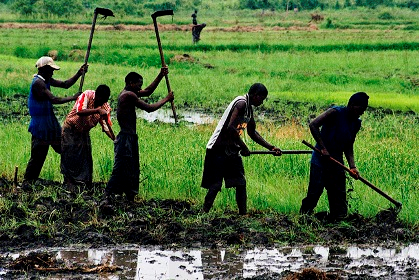
 Most of Senegal lies within the drought-prone Sahel region, with irregular rainfall and generally poor soils. With only about 5 percent of the land irrigated, Senegal continues to rely on rain-fed agriculture, which occupies about 75 percent of the workforce. Despite a relatively wide variety of agricultural production, the majority of farmers produce for subsistence needs. Production is subject to drought and threats of pests such as locusts, birds, fruit flies, and white flies. Millet, rice, corn, and sorghum are the primary food crops grown in Senegal. Senegal is a net food importer, particularly for rice, which represents almost 75 percent of cereal imports. Peanuts, sugarcane, and cotton are important cash crops, and a wide variety of fruits and vegetables are grown for local and export markets. In 2006 gum arabic exports soared to $280 million, making it by far the leading agricultural export. Green beans, industrial tomato, cherry tomato, melon, and mango are Senegal's main vegetable cash crops. The Casamance region, isolated from the rest of Senegal by Gambia, is an important agriculture producing area, but without the infrastructure or transportation links to improve its capacity.
Subscribe to:
Posts (Atom)