Sunday, November 7, 2010

Economy in Mughal Empire

Economy in Mughal Empire was dependent on agriculture, trade and other industries. According to historians, since time immemorial agriculture was actually the biggest source of income. Moreover, it was also one of the main sources of livelihood of majority of the people in the country. The major crops that were grown during the Mughal era included millets, oilseeds, cereals, hemp, chili, sugarcane, cotton, indigo, betel, and other cash crops. Indigo cultivation was at that time in various places like Agra, Gujrat etc. On the other hand, Ajmir was well known for the production of best quality sugarcane. Improved transport and communication facilities also helped the development of economy during the reign of Mughal emperors. There was tremendous demand for for cash crops like silk and cotton as because the textile industry was flourishing during the Mughal time.
Further during the reign of Jahangir Portuguese introduced the cultivation of tobacco and potato in India. Babur introduced several other central Asian fruits in the country. During Akbar Firoz Shah's Yamuna canal was repaired for irrigation purposes.
The Mughal emperors preferred to settle in cities and towns. The artistic lifestyle of Mughal rulers also encouraged art and architecture, handicrafts and trade in the country. During that era, the merchants and the trader class were dividedinto large business powers.            

Saturday, November 6, 2010

Fatullah Shirazi in Mughal Period


Fatullah Shirazi : Sometimes referred to as Amir Fhe Miatullah Shirazi.  Indian polymath - a scholar, Islamic jurist, finance minister, mechanical engineer, inventor, mathematician, astronomer, physician, philosopher, and artist - who worked for Akbar the Great, ruler of the Mughal Empire. Shirazi was given the title of Azuddudaulah, translatrd as :the arm of the empire".
Mir Fatullah Shirazi was a polymath who worked as an imperial finance minister for Akbar the Great. According to Abul Fazl ibn Mubarak's Akbarnama, when Shiraz died, Akbar mourned his death. Akbar grieved at the departure of this memorial of forme sages.He often said that the Mir was vakil, Indian Philosophy, physician, and astronomer, and that no one could understand the amount of his grief for him. "Had he fallen into the hands of the Franks, and they had demanded all my treasures in exchange for him, I should gladly have entered into such a profitable traffic, and have bought that precious jewel.
Inventions ; Among the inventios credited to him was a military weapon, fashioned for killing infantry, an early volley gun with multiple gun barrels simultaneously, and was operated by a cow. He also developed a seventeen barrel canon, fired with a matchlock.
Not all his creations were intended for warfare, however, including a carriage , which was called comfortable by Abul-Fazl ibn Mubarak. It could also be used to grind corn, when not transporting passengers.    

Science and Technology in Mughal Period

Fathullah Shirazi (c.1582), a Persian-Indian polymath and mechanical engineer who worked for Akbar the Great in the Mughal Empire, developed a volley gun. 
Considered one of the most remarkable feats in metallurgy, the seamless globe was invented in Kashmir by Ali Kashmiri ibn Luqman in 998 AH( 1589-90), and twenty other such globes were later produced in Lahore and Kashmir during Mughal time.It was believed by modern metallurgists to be technically impossible to produce metal gloves without any seams.These Mughal metaqllurgists pioneered the method of wax casting while producing these seamless globes.      

Thursday, November 4, 2010

Astronomy during Mughal Period

Astronomy ; The 16th and 17th centuries saw a synthesis between  Islamic Astronomy,where Islamic obsevational techniques and instruments were employed techniques. While there appears to have been little concern for theoritical astronomy, Mughal astronomers continued  to make advances in observational astronomy and produced nearly a hundred Zij treatieses.Humayun built a personal observatory in near Delhi, while Jahangir and Shah Jahan were also intending to build observatories but were unable to do so. The instruments and observational techniques used at the Mughal observatories were mainly derived from the Islamic tadition. In particular, one of the most remarkable astronomical instruments invented in Mughal India is the seamless celestial globe .
     

Mughal Empire (contd-3)

A. Induus Valley Civilisation-2000 BC
B. Maurya Empire-250 BC
C. Gupta-Empire-AD 400
D. Delhi Sultanate-AD 1335
E. Mughal Empire - AD 1600
F. British India - AD 1914
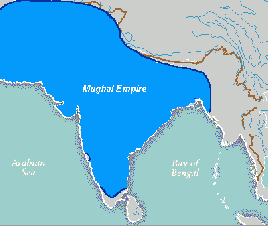
Expansion of Mughal Empire during Aurangajeb

Wednesday, November 3, 2010

Mughal Empire (contd-2)

Agrafort ; A major contribution to the Indian Sbcontinent was their unique architecture, a centralised Government, amalgamation of persian and Indian art and culture, trade routes to Arab and Turkik lands, development of Moghlai Cuisine, a language known as Urdu, uniform currency and unification of the country, key industries like shipbuilding, textiles and steel.
Economic Condition of the people; The nobility was a heterogeneous body, while it primarily consisted of Rajput aristocrtsand foreigners from Muslim countries. The middle class of openly affluent traders consideredof a few wealthy marchants living in the coasteal towns, the bulk of the merchants pretended to be poor to avoid taxation. The bulk of the people were poor. The standard of living of the poor was as low as, or somewhat higher than, the standard of living of the Indian poo under the British Raj. .  
Fatehpur Sikri;
Babri Masjid
Dhaka Lalbagh
Delhi Jama Masjid
Babur Tomb
Lotus Temple
Qutub Minar


Tajmahal

Tuesday, November 2, 2010

Mughal Empire (contd-1)

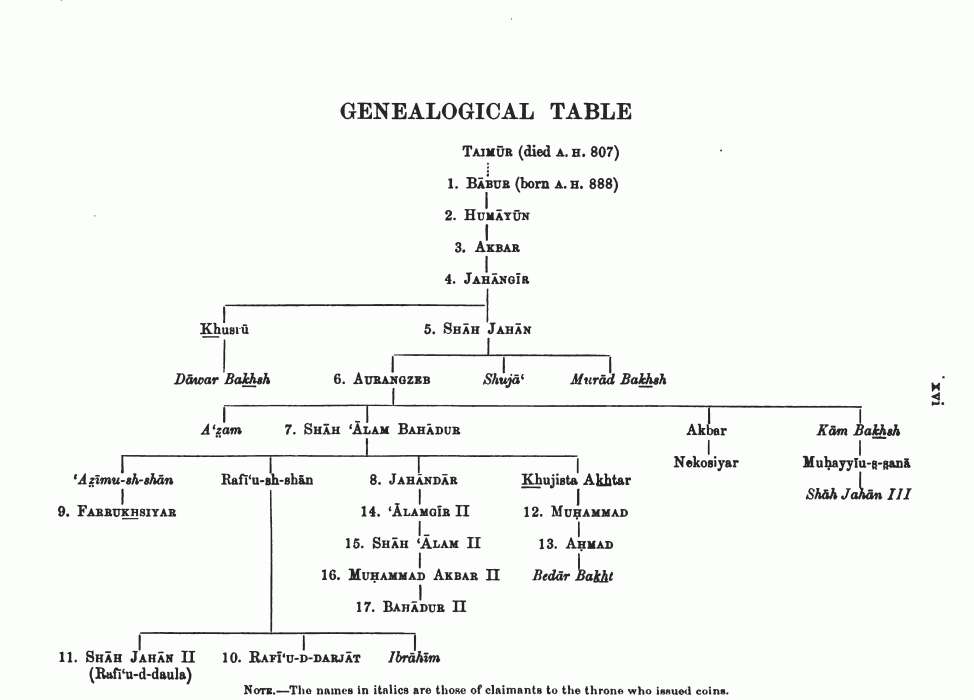
Emperors.................Period
1.Babur............1526-1530
2. Humayun   ...1530-1539,
                      1555-1556
3.Akbar............1556-1605
4.Jahangir..........1605-1627
5.Shah Jahan......1628-1658
6.Aurangzeb......1658-1707
7.Moazzem........1707-1712
8.Jahangir Shah..1712-1713
9.Pharukhshiar....1713-1719
10.Rafiuddolla
  2nd Shah Jahan.1719
11.Rafi-ud-rajat...1719
12.Mahammad
                 Shah...1719-1740
13.Ahmmad Shah..1748-1755
14. 2nd Alamgir.....1755-1759
15. 2nd ShahAlam..1759-1806
16. 2nd Akbar Shah1806-1837
17.2nd Bahadur Shah1837-58
       (last king)