The Government of Bhutan is a constitutional monarchy; between 1907
and the 1950s however, Bhutan was an absolute monarchy. The peaceful march to
democracy has been a steady one. The King of
Bhutan is head of
state. Executive power is exercised by the Lhengye
Zhungtshog, or council of ministers, headed by the Prime
Minister. Legislative power is vested in the bicameral
Parliament, both the upper National Council and the lower National Assembly. A royal edict
issued on April 22, 2007 lifted the previous ban on political parties, ordering that they be
created, in anticipation of National Assembly elections to be held the following
year. In 2008, Bhutan
adopted its first modern Constitution, codifying the institutions
of government and the legal framework for a democratic multi-party
system
The Bhutanese people have historically never had doubts about their nation's
sovereignty. Bhutan in fact has never been colonized. However, to the outside
world, namely India and before that the British Raj, Bhutan was viewed as less
than sovereign for their own geopolitical interests. Bhutan was treated as a suzerainty by the British Raj,
during which time the present monarchy was established. Foreign and defence policy
was to be decided by the British according to the 1910 Treaty of Punakha.
This did not mean so much to the Bhutanese however due to their policy of
self-imposed isolation. In 1949, after Indian
independence, Bhutan and India agreed to a ten-article, perpetual treaty
which effectively continued the relationship, but with India taking the place of
the United Kingdom. That is, India agreed not to interfere in Bhutan's internal
relations, while Bhutan agreed "to be guided by the advice of the Government of
India in regard to its external relations" (Article 2). The treaty also
established free trade and full extradition between the two countries.[3]
While Bhutan sees its destiny as being closely linked with that of India, for
which reason it strives to promote excellent relations with it, it has also
quietly striven to assert its sovereignty at the same time.
Article 2 of the 1949 treaty has mostly been ignored by both countries as
Bhutan confidently handles all of its foreign affairs, including the sensitive
border demarcation talks with China.
In February 2007, the Indo-Bhutan Friendship Treaty was substantially revised
with all references to phrases such as "will be guided" deleted, thus
eliminating the last lingering doubts about the sovereign and independent status
of Bhutan.
Thursday, October 4, 2012
Wednesday, October 3, 2012
Economy of Bhutan

Bhutan's economy is based mainly on agriculture, and forestry which provide the main livelihood for 80% of the population and account for about 40% of GDP. Although the living condition of most of the people in Bhutan do not seem as dire as that of the poor peoples of other third world countries mainly owing to our small population, Bhutan is without doubt, one of the least developed countries in the world.

The Government of Bhutan gets most of its revenue from selling hydroelectric power to India. Chhukha Hydroelectric Power Corporation supplies elecricity to the northern states of India. Thus we get money from them. There are two more huge hydro-electric power projects, Tala and Kurichhu, under construction at this time. After their completion, it is hoped that our revenues will be further increased. Other sources of revenue include tourism and minerals like coal, gypsum, cement production and ferro-chemicals.
Agriculture consists largely of subsistence farming and animal husbandry. Rugged mountains dominate the terrain and make the building of roads and other infrastructure difficult and expensive. The economy is closely aligned with India's through strong trade and monetary links.
The industrial sector is technologically backward with most production of the cottage industry type. Most development projects such as road construction rely on Indian migrant labor.
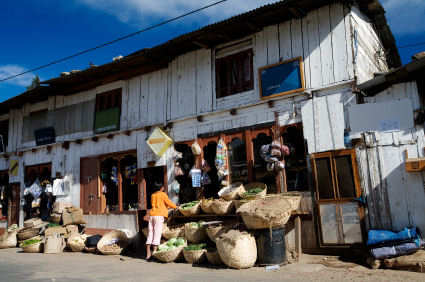
Bhutan's hydropower potential and its attraction for tourists are key resources. The Bhutanese Government has made some progress in expanding the nation's productive base and improving social welfare. Model education social and environment programs in Bhutan are underway with support from multilateral development organizations. Each economic program takes into account the government's desire to protect the country's environment and cultural traditions.
GDP growth averaged 5% per year in 1991-95 with information not yet available for 1996-97. Detailed controls and uncertain policies in areas like industrial licensing trade labor and finance continue to hamper foreign investment.
GDP: purchasing power parity—$1.3 billion (1995 est.)
GDP—real growth rate: 21.4% (2008 est.)
GDP—per capita: purchasing power parity—$730 (1995 est.)
GDP—composition by sector:
agriculture: 42%
industry: 32%
services: 26% (1995 est

Tuesday, October 2, 2012
Industries of Bhutan
Industries of Bhutan
Industrial Resources
Bhutan is one of the least developed countries in the world. Before 1960s, manufacturing was a household work and a few items like agricultural implements, weapons, handicrafts, wood product; bamboo products etc were produced on a small scale. However, after 1961, the number of industries expanded steadily. Nevertheless, industrial development experienced relatively in slow pace in Bhutan due to weak entrepreneurial orientation, high transport cost, small domestic markets, underdeveloped infrastructure and lack of resource inventory.
Ferro-Silicon Plant at Pasakha, Chukha
Major Industrial Region of Bhutan

The manufacturing industry in Bhutan is dominated by a small number of major operators such as the Penden Cement Plant, the Bhutan Board Products Limited., the first chemical plant, Bhutan Carbide and Chemicals Limited, the Bhutan Ferro Alloys Limited and Bhutan Agro Industries Limited. Besides these, there are a number of other small manufacturing plants located in various parts of Bhutan.
Bottling Plant
Chhukha Dzongkhag: The industrial area in this Dzongkhag extends from the confluence to the southern borders with many large, medium, and small industries, making the Dzongkhag the most industrialized dzongkhag in the country. The important industrial centres are Pasakha, Dala, Gedu and Phuntsholing. The extensive road network, the massive power generation and the Dzongkhag’s proximity to the Indian market provided ideal conditions for industrial development. The dzongkhag is also a base for a range of other industries like floor mills, beverages, bottling plants etc. Thus, this dzongkhag is widely perceived as the industrial heartland of the country.

Penden Cement Plant at Gomtu, Samtse
Samtse Dzongkhag: This is another important industrial dzongkhag in Bhutan. The outstanding industries in this dzongkhag are Fruit processing, cement and milk processing. The important centres are proper Samtse, Gomtu and Tashijong. Some of the large scale industries such as Penden Cement Authoruty Ltd., Lhakhi Cement and Yangzom Cement Private Ltd are localized here.
Pema Gatshel Dzongkhag: The construction of 28 km road which stretch from the entire Dzongkhag to Tsheling Khor, the national highway between Samdrup Jongkhar and Trashigang and the mining of Gypsum has been an imputes that boosted Pema Gatshel dzongkhag as one of the industrial regions in the country. Gypsum from this mine is the raw material base for the establishment of three plaster of Paris manufacturing units.


 Agriculture in Bhutan has a dominant role in the economy of the country. In 2000, agriculture accounted for 35.9% of GDP of the nation. The share of the agricultural sector in GDP declined from approximately 55% in 1985 to 33% in 2003. Despite this, agriculture remains the primary source of livelihood for the majority of the population. Approximately 80% of the population of Bhutan are involved in agriculture. Over 95% of the earning women in the country work in the agricultural sector. Majority of the refugees in this Himalayan nation are also employed in the agricultural sector. Agriculture in Bhutan is characterized by its labor intensive nature with relatively low intensity of farm inputs. Most of the peasants in the country are small and marginal.
Among the agricultural lands in the nation, an estimated 21% are wetland (irrigated), approximately 43% are dryland (rainfed), nearly 27% are used for shifting cultivation, approximately 8% are used for orchards and 1% are kitchen gardens.
Major crops cultivated in Bhutan are maize and rice. Maize accounts for 49% of total domestic cereal cultivation, and rice accounts for 43%. Rice is the major staple crop. Agriculture in the country includes cultivation of wheat and other minor cereal crops. Paddy is the primary crop in those regions where proper irrigation is available. Apart from paddy, other crops like wheat, barley, oil seeds, potato and different vegetables are also cultivated in these lands. Maize is mainly cultivated in dryland regions at lower elevation. Forests in the nation act as the source of livestock fodder and organic materials for the purpose of development of fertility. Forests are also responsible for regulating the availability of water for agricultural purpose. The primary goals of agriculture in Bhutan are to raise the per capita income of the people living in rural areas, to enhance self-sufficiency in staple crops, and to increase the productivity per unit of farm labor and agricultural land. Agriculture is hampered due to irrigation problem,[6] rough terrain, poor soil quality and limited number of arable lands.[3] But several other factors have contributed in the development of agriculture. These factors include improved quality of various cereal seeds, oil seeds, and vegetable seeds, use of fertilizers, mechanization process and trained agricultural experts.[6] The agricultural sector have experienced development especially in the following projects:
Geylegphug Development Project
Punakha-Wangdi Valley Development Project
Tashigang-Mongar Area Development Project
Chirang Hill Irrigation Development Project.[6]
Production of cash crops such as apple, orange and cardamom have increased and have become profitable. In several areas the shifting cultivation is being replaced by the orchard cultivation. Academics expect this will increase the cultivation of cash crops.


Rivers of Bhutan
Western Bhutan
 Jaldhaka River or Di Chu [1]
Amo Chhu or Torsa [2]
Wong Chhu or Raidak [2]
Ha Chhu[2]
Paro Chhu[2]
Thimphu Chhu[1]
Mo Chhu or Sankosh River[2]
Pho Chhu[2]
Tang Chuu.[2]
Eastern Bhutan
Manas River[2]
Mangde Chhu or Tongsa [2][3]
Bumthang River or Murchangphy Chhu [2]
Drangme Chhu [4] (sometimes considered part of the Manas River)
Kuru Chhu or Lhobrak[2]
Kulong Chhu[2]
Womina Chhu[5]
Tawang Chhu or Gamri[1]
Pagladiya River[6]
Puthimari Nadi[6]
Dhansiri Nadi[1] References

 2. a b c d e f g h i j k l "Physiological Survey". River System of Bhutan. FAO Corporate Document Repository. Retrieved 2010-05-09.
 Jaldhaka River or Di Chu [1]
Wong Chhu or Raidak [2]
Ha Chhu[2]
Paro Chhu[2]
Thimphu Chhu[1]
Mo Chhu or Sankosh River[2]
Pho Chhu[2]
Tang Chuu.[2]
Eastern Bhutan
Manas River[2]
Mangde Chhu or Tongsa [2][3]
Bumthang River or Murchangphy Chhu [2]
Drangme Chhu [4] (sometimes considered part of the Manas River)
Kuru Chhu or Lhobrak[2]
Kulong Chhu[2]
Womina Chhu[5]
Tawang Chhu or Gamri[1]
Pagladiya River[6]
Puthimari Nadi[6]
1. a b c d Tibet Handbook. Footprint Handbooks. p. 872. Retrieved 2010-05-10.

 2. a b c d e f g h i j k l "Physiological Survey". River System of Bhutan. FAO Corporate Document Repository. Retrieved 2010-05-09.
3."Rivers and Lakes". Retrieved 2010-05-09.
4. "Potential Development Challenges in the Rivers of Bhutan". Retrieved 2010-05-09.[dead link]
5. Assessment Report, Department of Energy of Bhutan
6. a b "Geonet Names Server". National Geospatial Intelligence Agency. Retrieved 2010-05-10
Subscribe to:
Posts (Atom)